


Read Full Transcript
Transcript
Jason Randall: It seems like almost every business conversation we’re in these days has some sort of AI aspect to it.
A lot of that conversation can be too technical to be actionable, or too vague to know what to trust and what to do next. I think what business leaders actually want to know is much more simple and fundamental:
How does this massive breakthrough apply to my business?
Where do I start?
And what does it do to my people when I do?
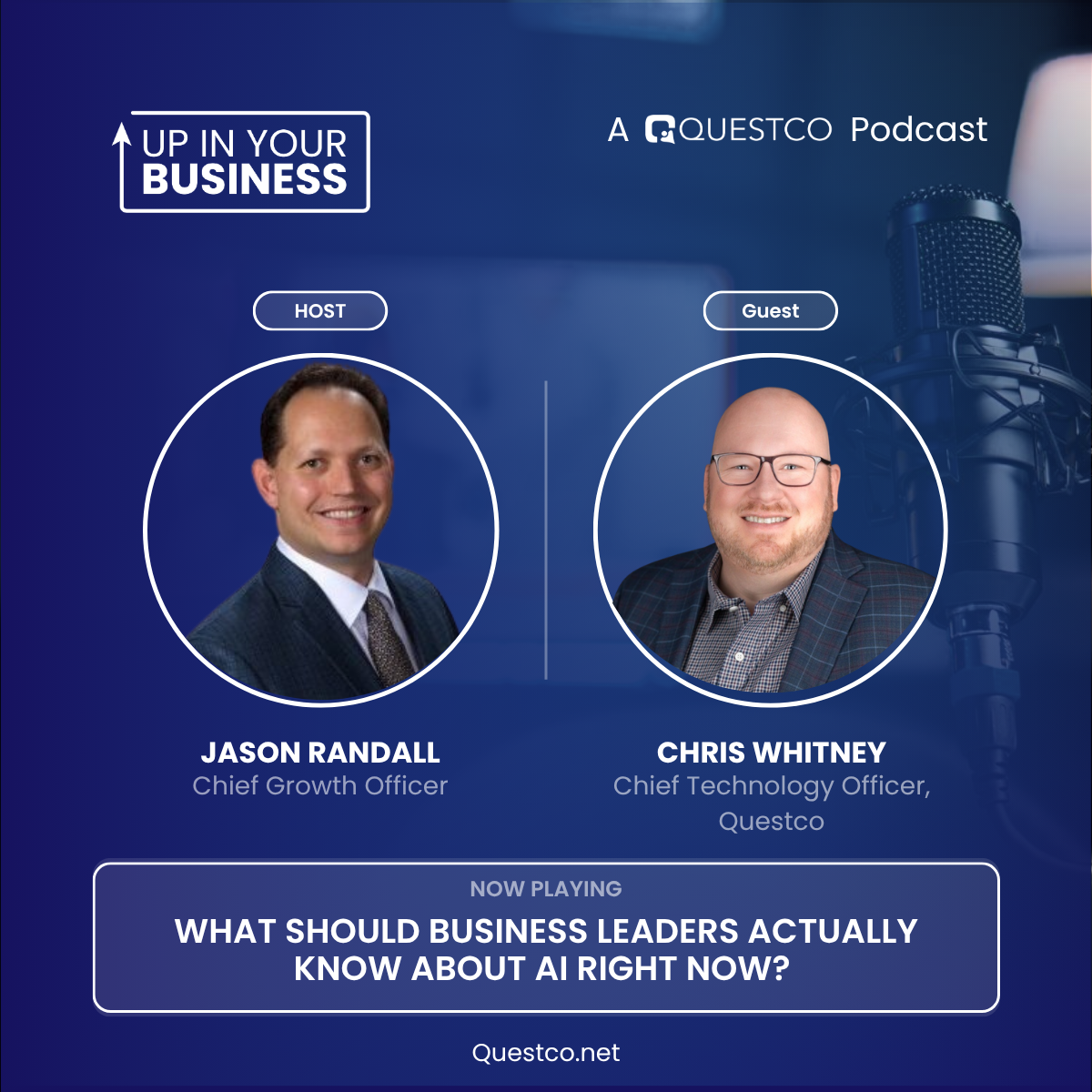
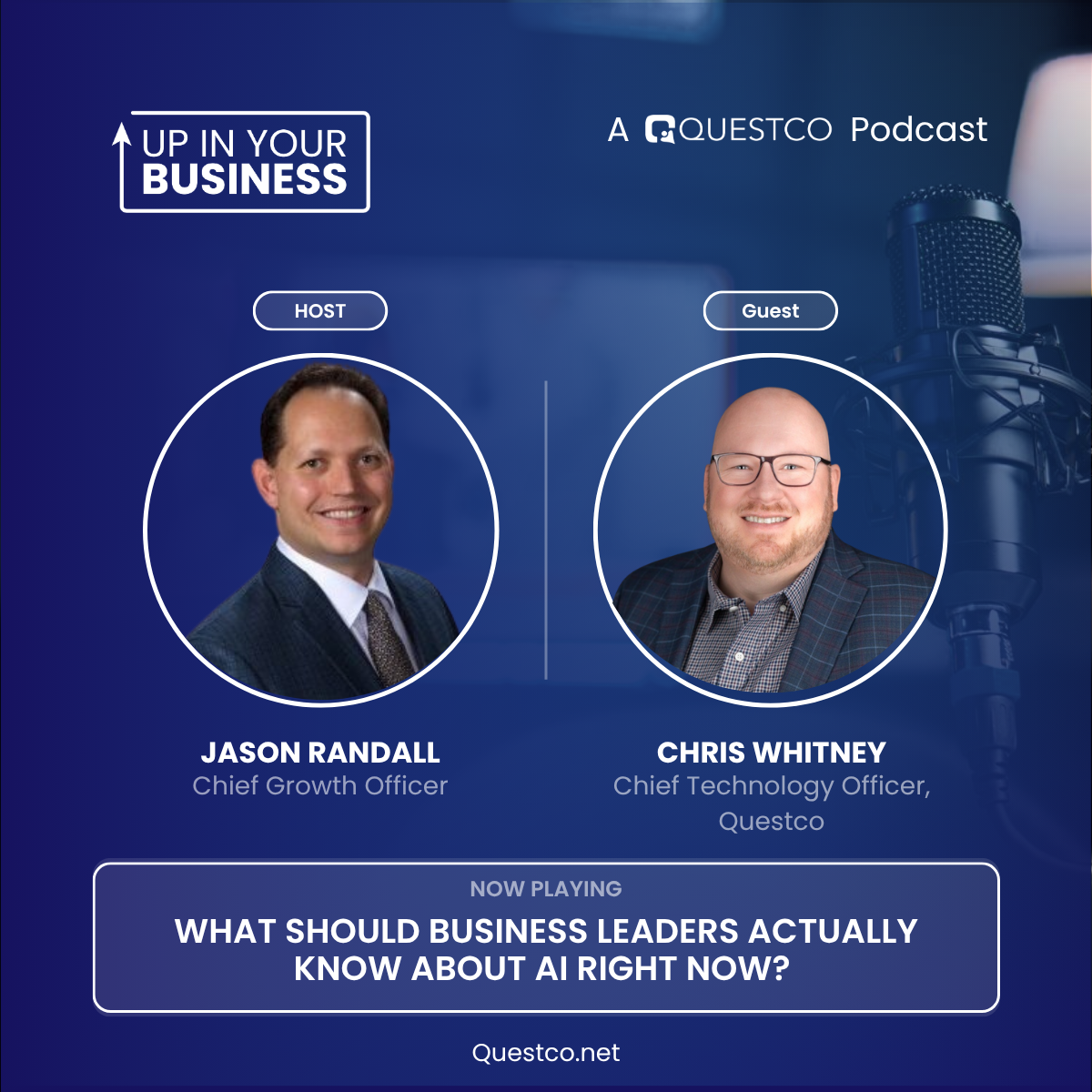
So we wanted to get a true expert and a true pioneer in this space, our own technology leader at Questco, Chris Whitney, to give us some perspective on these issues.
Chris is a leader inside our company who has done the work. We’re going to walk through some conceptual things, some philosophical principles, and also a really practical example to help you move forward with your own initiatives.
In just 90 days, Chris and his team built an AI agent. In our case, the purpose was to handle benefits inquiries. Research time was cut down from 20 to 30 minutes per question to a near-instantaneous response, simply by removing the work that was getting in the way.
So in a nutshell, this episode is about what it looks like to deploy AI inside a people-driven business. What works, what doesn’t, and how leaders can think about AI without getting distracted by the hype.
Chris, I’m so excited to introduce you. Welcome to the conversation.
Chris Whitney: Thank you so much, Jason. I’m happy to be here.
AI seems like a topic every single day, and it’s starting to really become part of our DNA as a business. I’m very excited to share, and I’m really excited to look back at this conversation a year from now and see how different things are, because the pace of change is so rapid.
Thank you for having me.
Jason Randall: All these conversations are time capsules, and this one will certainly be interesting to look back on.
That said, I think we have a lot of practical advice for people who want to get started right now. Before we dive into AI, could you tell us a little bit about your background?
Chris Whitney: Sure. I’m happy to.
I spent my early career as an engineer and developer, really hands-on with technology, software engineering, and development. I spent about 18 or 19 years in media and entertainment, where I held different roles around technology and eventually moved into senior leadership.
I left media and joined Questco about two years ago. I came into the PEO space because it was such an exciting time with what was happening around AI and the changing types of services we provide to our clients.
I saw an opportunity at Questco to help with the technology footprint, and I loved everything Questco stood for, especially our care for our clients.
I’ve been at Questco for about a year and a half now. I’ve really enjoyed my time here. I think I’m half hands-on and half driving strategy and leadership, and I love everything I’m part of here at Questco.
Jason Randall: In addition to being a delightful person, you’ve been an amazing transformational change agent. You’ve helped us work through a lot of these issues and get to a place of more sophistication.
So let’s rewind in our own history, but also talk about something much more common. When business leaders hear about AI, what do they usually get wrong, misunderstand, or have inaccurate expectations about when it comes to using AI in their businesses?
Chris Whitney: If you had asked me this question six months ago, I think I would have answered it very differently.
One of the fundamental things a lot of leaders are getting wrong is the complexity of where to start. The AI tooling, especially the connectivity and how smart and robust some of these agents and model-connectivity frameworks are, has changed the barrier to entry.
The barrier for companies to start experimenting with AI smartly and responsibly is completely different now.
A lot of companies assume their initial investment strategy or barrier to entry might be significant. But there are a lot of avenues to start.
That might mean making sure your employees are equipped with responsible AI for the art of the possible, or it might mean leaning into real transformational opportunities.
The short answer is that you should question everything you know about the speed of accomplishing work in this new AI and agent-driven world.
Jason Randall: As a senior leader, I’ve been familiar with technology, but I’m not a technology expert. I often feel intimidated by this topic, just in terms of where to start and what is already going on.
Could you comment briefly on where AI is already showing up in business operations, whether leadership realizes it or not?
Chris Whitney: Especially in our space, the PEO space, the first question you have to ask yourself is whether you are being responsible.
Responsible with your clients’ data.
Responsible with your company’s data.
Responsible with where you inject AI.
From a where-to-start perspective, I think you have to look at your workforce.
You have to make sure your workforce is empowered with the right tooling to leverage AI for their day-to-day work.
That’s the first place to start: empowering individual contributors and leaders across the company to use tooling so they can generate documents faster, assess problems faster, and make AI part of their daily workflow.
Then, from there, you can unpack some really transformational opportunities.
Jason Randall: That’s a really good conceptual grounding.
We’ll come back to that toward the end of our conversation, but I want to launch right into a real-world example so people have something tangible to attach this to.
Before that, I’ll put you on the spot with a more general question: How do you separate what’s real, useful, and actionable from what is just noise right now?
Chris Whitney: There’s a concept in tech called “the new shiny,” and this is one of the hardest things.
One mistake is to overthink and over-plan. If you overanalyze and look too far into the future, you’ll stumble around without getting initiatives off the ground.
The most important thing is to take bets. Take calculated bets. Move, iterate, and allow yourself the opportunity to iterate.
It’s easy to overthink and overanalyze.
Another important piece is to stay educated and nimble. Technology changes. The models are developing quickly. The pace and speed of delivery are quick.
Here’s a real example. Six or eight months ago, you used to come to a model or AI and ask it to do a thing: write me an email, analyze this problem. Then you’d get your result and bring that result into your day-to-day workflow.
Now we’re starting to get to a point where agents and AI can actually do that work for you.
So my advice is to move. Try not to be too scared about how the technology and the market are going to change. Allow yourself to be agile enough to shift and change with it.
Jason Randall: That’s helpful.
As we were preparing for this topic, it became obvious that we could share a real-life example of something we did at Questco to move farther faster. I’m proud of your work in this area.
So let’s introduce our audience to BETH, all caps. We’ve gendered BETH as “her,” but this is really an AI case study.
What problem were we trying to solve, and how did you decide AI was the right answer?
Chris Whitney: I think it’s a great use case, and we’ve learned so much from it.
BETH was essentially a knowledge-driven chatbot.
Where we started, especially for PEOs, is that data is an asset. Data is an asset to us, and data is an asset to our clients.
In Questco’s case, we had a strong benefits library. We had curated standard operating procedures, benefits guides, details on our plans, and a strong data repository that we could point AI toward.
That gave our benefits team and benefits specialists the ability to have conversational questions back and forth with that data, so they could respond to our clients faster.
Before BETH, there was a lot of back and forth with standard keyword searches and looking for different documents. We saw a real opportunity because we had a curated knowledge base of content we could point AI toward.
It was fairly easy for us to stand up an agent in front of that. Since then, it has evolved into other really useful things.
That was a strong way for us to quickly take a robust data solution and put an AI chat experience in front of it, so people could query and ask questions about that data.
Jason Randall: It’s probably helpful to add context.
As a PEO, or Professional Employer Organization, our clients trust us to help them with benefits broadly. Within that, there are consequential day-to-day decisions about administering benefit plans.
These can be highly emotional decisions. Facts matter. Time matters.
Historically, we threw expertise at this and had human-centered solutions. But there were still times when we felt stretched, and it was an expensive thing for us to execute day to day.
With BETH, could you walk through the build decision? How did building BETH help make our clients more at ease and help us serve them better?
Chris Whitney: The first thing is responsible AI.
A lot of the information we were using was public. It’s public information on our carrier site. So we weren’t dealing with proprietary, sensitive, personal client information.
That made this a good AI opportunity right off the bat. We were essentially curating content that was publicly available and not sensitive.
That’s number one.
Number two, Questco had already done a good job, through our benefits team, of bringing that data into a single repository. We were able to point AI at that relatively quickly and surface information across the documents in that repository.
It was essentially a document library, and it was a fairly straightforward shift from search to an AI-driven chat experience.
Jason Randall: So what was sometimes a needle-in-a-haystack problem became much sharper and faster through the use of technology. We could get to the right answer much more quickly for our client or their employee.
Chris Whitney: Absolutely.
Another thing to call out is what we learned throughout the journey.
It’s easy to look at a business process and try to replace it with AI in a one-to-one way.
For example, a client has a question about a benefits plan. A benefits specialist goes into the library, searches for the details, reads through the information, and sends the answer back to the client.
It’s tempting to point AI at that same process and say, “Great. AI will solve this.”
What we learned, and what we are still learning, is that it’s not that simple. You have to inject a new AI-driven process.
Most of the time, AI gets the problem right, but sometimes it doesn’t. So the process becomes: the specialist goes to AI, AI provides an answer, the specialist validates that answer, and then the specialist goes back to the client.
That is a new AI-driven process.
It means looking at the process differently, and that was a major lesson learned. We’ve learned the same thing across many of the AI-driven processes we’re delivering at Questco today.
Jason Randall: Before we decided to build this, there were several options to solve this fundamental problem.
We could hire more people.
We could build something custom.
We could continue down a path with other technologies.
How did you think through that? You had to ask for money, senior leadership commitment, and all those things. How did you get yourself convinced, and then how did you make that case?
Chris Whitney: It’s interesting because even if I think about this problem today, we would be able to bring it to market so much faster than the initial 90 days it took last year.
For us, what mattered was that we had already anchored into technology we could leverage. That technology gave us the ability to create AI on top of it and create AI-driven chat experiences.
So one easy path was to leverage an existing technology investment.
Then, second, we decided not to overthink the process and bring in a lot of third-party spend, contractor spend, or consultant spend.
We wanted to make it easy. Leverage what we already owned, use the curated library we already had, and see whether we could bring an AI-driven chat experience to the business that would be beneficial.
Jason Randall: I think you alluded to this, Chris, but what went wrong?
When we first deployed this, what did we find ourselves wrong about? Where were our assumptions not only challenged, but flat-out erroneous?
Chris Whitney: The two major pieces were, number one, building a new AI-driven process and not looking at processes as linear.
If we think about taking a lot of manual work and replacing it with an agent, that work and that process have to be reconsidered in an AI-driven world. That was one fundamental learning.
The other major piece was change management and adoption.
You have to allow yourself time to bring your agent or AI solution to the team. Then you need time to adjust, change, revise, and create room for change management.
It’s not “build it, set it, and forget about it.” It’s a living thing that changes.
So change management was a major piece.
Jason Randall: There’s something implicit in your comments that I want to draw out and emphasize.
There’s always a dilemma when we talk about AI: Are we replacing people? Are we augmenting people? What is going on fundamentally?
Internally, our business goal is to amplify the team, not replace the team. But there’s a lot of nuance in that.
Could you share your perspective on what that actually means in day-to-day operations?
Chris Whitney: That’s such a great question, and it’s one companies are dealing with every single day.
For us at Questco, it’s important to empower our specialists and teams to replace really heavy manual work by leveraging AI.
Tasks that used to take a lot of time should be brought into AI so employees can use their time in other places, like responding to clients, building relationships, and progressing or changing our processes.
That piece is fundamental.
If you’re a leader and you’re looking at AI purely through the lens of replacing roles, I think that’s the wrong thinking.
You need to look at it through the lens of augmenting your staff so they can focus on the most important strategic work and spend more time with your clients.
And if you’re an employee worried about what AI could do to your current role, I think you should look at it through the lens of how AI can help you be more empowered and quicker in the way you operate every day.
Jason Randall: There’s a powerful lesson there that I hadn’t heard articulated in quite that way.
You’ve taught me a ton: solve one thing really well, ship fast, and emphasize people inside of that process.
Not only can you be closer to the mission, in this case by providing authoritative and responsive service, but the cost savings were massive. In our case, about 80% cost savings, while serving clients better than we ever have in that area.
That focus aspect is something I don’t hear the business community talking about enough. I think that’s powerful advice.
Chris Whitney: This is something I’ve seen in 2026: the speed of delivery, particularly on technology, is changing every single day.
Technology teams should be questioning the speed at which traditional tasks and projects have taken place, because in an AI-equipped world, we are so much more efficient.
Continuing to challenge yourself on that thinking is a healthy thing.
Jason Randall: Let’s move from our own example to the listening audience.
If a business leader is hearing this story and wants to get more involved with AI, wants to move from confusing conceptual conversations to something tangible, where should they actually start?
Chris Whitney: If you’re a leader and you’re looking to do more with AI, the first question you have to ask is: Do you have a mechanism and the right people to experiment with AI responsibly?
You have to do it.
There’s so much technology out there. There are so many models out there. Pick a path, have conviction in that path, do it, and iterate.
The most important thing is asking whether you have an avenue to explore.
And if you’re a small PEO or a small company, you don’t have to have a robust technology team. That’s important.
You need people who can champion, lead, and experiment with AI, but those people do not have to be traditional technology or IT people.
They can be curious business analysts. They can be curious interns.
AI is now so good at educating, problem-solving, and assisting with the creation of technology-based solutions that you can empower your existing staff to iterate.
The first place to start is creating an avenue for experimentation and development.
Jason Randall: I was in a seminar last week where the speaker walked through an AI-enabled solution that had hundreds of steps. It brought in outside databases, synthesized information, and automated a process that used to take several people weeks or longer.
It was impressive, but it was a lot. Especially for a non-technical person.
So “just do it” sounds great, but can you give us a more specific prescription? What makes a good first AI problem that a non-technical executive might be able to dive in and solve?
Chris Whitney: That’s a great question.
Let’s first talk about a fundamental concept: vibe coding.
Vibe coding is when, rather than having traditional developers or engineers build and write code, the AI does it for you and deploys it for you.
That concept is helping the speed and pace of innovation skyrocket.
If you take that concept, you want to choose a use case that has little risk.
In the PEO space, you’re not going to vibe code payroll. You’re not going to vibe code compliance. Those are not the types of use cases you start with.
You want to start with something less risky.
A good example is the internal creation of standard operating procedures that a human can check.
Have AI create that standard operating procedure for you. Then have a person review it. If AI hallucinates or does it wrong, you improve it and iterate.
That’s a very low-risk thing.
You have to be smart about where you start. If you’re going to rely on AI to do work or build solutions for you, you need a human in the middle to safeguard that work. Then you can continue to evolve and iterate on your AI.
Jason Randall: So it can be a meaningful issue and consequential to the business, but it shouldn’t be the most important reason the business exists.
Chris Whitney: That’s absolutely correct.
Jason Randall: Something else you taught me, and something I’ve really embraced and enjoyed, is that the AI models themselves can help teach us.
You can ask the model what would make an idea better. That is different from any other technology paradigm we’ve had before.
We can collaborate with the technology in real time, in the moment, and iterate toward better answers along the way. That’s really cool.
Chris Whitney: I’ll give a good example.
I’ll try not to be too geeky or too technical.
Before AI, when a technology team was going to build software or an application, we would do a lot of research to figure out the best way to build it.
Then we would talk to other teams. They might be doing it differently. We would take their input, build, learn, take more input, and keep improving.
Now we can use AI as that path to iterate and determine the best way to build a piece of software or solve a problem.
We can do that at lightning speed and find optimal paths.
This is not saying, “AI, should I do it?” and then taking the answer and running with it. This is giving the right prompts into AI to help steer the answer in the right direction.
Jason Randall: That makes sense.
Two themes are emerging in this conversation.
The first is: don’t be afraid. Jump in, do some basic interactions, and it’s okay to collaborate with AI in your organization to solve a meaningful problem.
The second is trust, verification, data integrity, and security. Those act as a buttress to all of this.
How do you think about getting people to trust the tools, getting leadership to trust the outcomes, or trusting the AI programs and models themselves? Where do the limitations come in, and how should leaders navigate them?
Chris Whitney: That’s a fantastic question.
Let’s talk about trust in two ways: trusting AI with our data, and trusting AI to do the thing we want it to do.
If we’re talking about trusting AI with our data, the first question you have to ask before injecting AI is whether you have the right data controls.
You need to control what client data is, what sensitive data is, what restricted data is, what PII is. Those are important things for any company of any size.
Before you even talk about putting AI on top of that, you have to answer those questions.
So you need to look at the types of data you’re using, how you’re using it, and how you’re using it with AI. That’s how you establish trust.
Then there’s the question of whether AI is going to do the thing you want it to do.
This is where it’s important to ride that journey together. Put a person in the middle. Make sure they validate the information coming out, check what’s there, and apply practical judgment to what AI provides.
That will serve you well because as AI gets better at solving the problem, you’re going to become more efficient with that process.
All roads lead to making sure your people are equipped to measure trust coming out of AI and making sure they are injected into the middle of those processes.
Jason Randall: Chris, you’ve been an amazing and inspirational force for me personally in blending the philosophical with the practical, all wrapped in an ethos of true enthusiasm and partnership.
I’ve been delighted to be your colleague and to work through some of these issues with you.
Where can listeners follow your work, stay connected to you, or get connected with you?
Chris Whitney: NAPEO is a great one. I publish there often.
Questco.net is another place. We have a blog series coming up there.
And then LinkedIn. I post a lot on LinkedIn, so those are all great avenues.
I’ll leave us with a little bit of advice.
The types of problems you used to solve, and the types of problems you felt you had to have people for, can be rethought completely differently in an AI-driven world.
If you’re a technologist and you said in the past, “I don’t code. I’m an IT person and I don’t code,” you can challenge that thinking now.
Because of the tooling and the richness of the models out there, you can challenge your thinking. With the skills you already have as a professional, powered by what you can do with AI, the world is your oyster.
In the technology world, I call them super-architects. AI is going to give people superpowers, and I think that’s really valuable.
Jason Randall: You’ve helped me appreciate that AI is another valued colleague. It helps magnify my own thinking, productivity, and contribution.
I couldn’t ask for a better colleague, not only in AI, but in you, Chris Whitney.
Thank you so much for your thoughts.
Chris Whitney: Thanks, Jason. That was very nice. I appreciate that.
Jason Randall: And to our audience, thank you for tuning in to this episode of Up In Your Business.
If this conversation helped you think more clearly about where AI fits in your business and what to actually do about it, please share it with a leader or operator who’s in that exact conversation right now.
You can see more resources and find more episodes in the show notes, and we’ll see you next time.