





Read Full Transcript
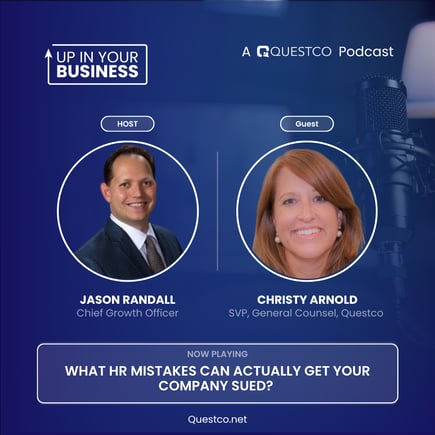
What HR Mistakes Can Actually Get Your Company Sued? with Christy Arnold
Please enjoy this transcript of Jason Randall’s conversation with Christy Arnold, General Counsel and SVP at Questco. In this episode of Up In Your Business, Jason and Christy discuss the HR mistakes that create real business risk, including misclassification, hiring technology, lack of documentation, inconsistent policies, termination decisions, and manager training.
This episode is for business leaders who want practical guidance on where HR risk actually begins and how to address small people issues before they become bigger legal, financial, or operational problems.
Jason Randall: Welcome to Up In Your Business, brought to you by Questco. I’m Jason Randall, Chief Growth Officer at Questco and your host.
This is the podcast for business leaders who want straight answers on HR, people, and growth without the fluff. We’re talking real scenarios, real risks, and real solutions. Let’s dive in.
A lot of business leaders assume HR risk shows up in a loud and flashy way: a lawsuit, a claim, a messy termination, or a scary letter from a government agency.
But most of the time, the real problem starts much earlier.
Incorrect employee classifications. Inconsistent handling of people issues. Missing documentation. Or a rushed termination. The policies might exist on paper, but they’re not being practiced.
Today, we’re talking about the HR mistakes that seem small in the moment but can create real liability for a company, and what leaders can do to reduce that risk.
So with me today is someone who has been indispensable in helping us at Questco work through a lot of issues on behalf of our clients: our General Counsel and SVP, Christy Arnold.
Christy, welcome to the conversation.
Christy Arnold: Thank you, Jason. Excited to be here.
Jason Randall: Well, let’s talk about why you’re excited to be here and how you got involved in our industry, and to Questco specifically, dealing with HR issues.
Christy Arnold: I guess I’ve been practicing law for about 28 years. Seems like a long time.
Jason Randall: It’s a big number.
Christy Arnold: But I started out in California in employee benefits. That was really the first time I had an opportunity to work with employers who were trying to implement employee benefits, whether it was retirement plans or health and welfare plans for their employees.
I was really working with them to understand the challenges they were facing while trying to provide benefits, as well as trying to manage the cost, complexity, and compliance pieces of it.
That really is what led me into the PEO industry. The benefits piece was definitely a good launching pad into the PEO world, where we were able to offer more employee benefits to a wider range of employers.
But you were still solving for the same problem for those employers, while also broadening that out to more compliance issues, state regulation, HR, employment law, and the additional complexity that comes with all of these clients.
Being able to help them solve these problems is what has kept me in the industry over the last 15 years, and I really enjoy it every day.
Jason Randall: So in those multiple decades of experience, you’ve just seen a ton, right? When you look at the HR issues that create the most trouble for businesses, what kind of mistakes show up again and again?
Christy Arnold: One of the biggest mistakes I think we see over and over is tough conversations. People not wanting to have tough conversations.
Nobody enjoys having hard conversations with their employees, especially when these are people they work with every day. They might be friends with them.
Small issues arise, and what really could be solved at a very minor level ends up being misinterpreted and not addressed. All of a sudden, they escalate into something that, in most cases, could have been prevented.
That is one thing we really try to work with our clients on. When you have small issues, let’s talk about them. Let’s try to solve them while they’re still small.
If employees feel like they’re escalating something and they’re being heard, someone is listening to them, someone is acknowledging what they’re seeing as a challenge, then many times it can be resolved very easily in a way that is mutually beneficial to the employer and the employee.
But if the employee feels they’re not heard, that no one is taking them seriously, that no one thinks it’s an issue, then they keep trying to find a way to get attention so they can get their issue resolved. That is usually when other attorneys are involved.
Jason Randall: It’s more expensive then.
Does this come down to procrastination, avoiding the tough conversation, or is there more to it than that?
Christy Arnold: I don’t think it’s necessarily procrastination. I think most of the time people are hoping it will resolve itself. It’ll go away.
They think, “This is kind of a one-off. If we don’t address it, everything will be fine tomorrow.”
The problem is that then, many times, the employee or whoever raised the issue infers different reasons for it not being addressed. Whether that’s discriminatory, whether it’s retaliatory, they start going down a different path, instead of assuming the manager had good intentions and thought everything would maybe work itself out.
It’s not necessarily that people have bad intentions when they avoid it. They just don’t necessarily want to have a conversation directly about the issue, and that lack of a conversation ends up being misinterpreted by the employee.
Jason Randall: This is a super key point because I think a lot of folks might assume that when you think about an HR lawsuit, you’re picturing some really dramatic incident. Something that grabs you by the lapels and shakes you.
What you’re describing is something much more subtle, much more time-bound, and often starts much smaller.
So what is the misunderstanding here about how these situations actually begin? What would you say business owners and operators might overlook early in the process that they shouldn’t?
Christy Arnold: I think business owners are busy. Everybody’s busy. You’re trying to run a business, and there’s not a lot of time to stop and do training or talk with your managers and take them away from their current roles.
But if you take that time, it doesn’t have to be really formal or really long training. Having some time to get the managers together and remind them, “Hey, you’re here to help manage your people. You’re here to listen to your people. Be an active listener.”
If your direct reports or employees are having an issue, address it. Address it early. Know who to escalate that to.
If there’s an HR contact within the company, loop them in. They can help have some of those conversations.
But make sure your managers have the tools and feel confident that they know where to direct issues when they’re still small. It doesn’t need to go to HR only when it becomes a huge issue that is on the verge of a lawsuit.
These minor issues are where we’re trying to intervene and keep the business productive and keep everyone happy and moving in the right direction.
Jason Randall: Now, it’s still early in our conversation, but I think this is almost a takeaway. If you get one thing from our talk today, it’s address these things when they are still small.
Be early, be calm, and be proactive in the approach. I think that’s one of the things we help our clients address, both in mindset and in skill.
Would you say that one big takeaway for this audience is start small, start early?
Christy Arnold: Yes, absolutely.
We see that as a repetitive theme in so many of these issues that end up in lawsuits or EEOC charges. They start as a very minor concern that just wasn’t addressed directly.
Like I said, it’s not because someone is actively deciding they don’t want to address it. Most of the time, people are hoping it’ll go away and resolve itself. It really typically doesn’t.
They just escalate, and then the lack of action is misinterpreted by the employee as somehow being adversarial. Then it escalates.
Jason Randall: These challenges tend to manifest. They don’t age like fine wine, but rather like old fish, right, in terms of how they actually come across.
Get there early.
Any particular vivid examples come to mind of something that might have been much smaller in magnitude or expense had it been caught early and dealt with effectively at an earlier stage?
Christy Arnold: There was one situation I know of, and the interesting thing is that in most of these situations, the employer typically has their heart in the right place. They’re trying to do the right thing, but through a series of events, it’s misinterpreted and ends up in a very different place.
We had one situation where a worker was having some health issues, so they needed some leeway on scheduling. They had asked for a number of shifts off in order to clear their schedule for these appointments.
The employer was trying very hard to accommodate all of this and be as helpful as possible. As things progressed, they continued to maintain that schedule where they weren’t putting this individual on shifts they thought were going to conflict with future appointments.
The employee took that as if they had effectively been fired and were being retaliated against because they had health issues.
So it ended up in a lawsuit, where the whole thing at the beginning started with the employer trying to do something to accommodate an employee. The employee misinterpreted what was happening, emotions ran high, and it ended up in a very different place than where it started.
Jason Randall: That’s a pretty good launchpad to get a little deeper into the mistakes that actually create risk.
Now, we’re going to do our best to have a compliance-oriented conversation that’s very far from boring, so we’re going to get really vivid here.
One of the biggest things we see in our environment is a phenomenon called misclassification. I’m hoping you can enlighten our audience. What does that actually mean, and how do companies get this wrong?
Christy Arnold: Misclassification can occur in a couple of different ways.
In some situations, you can have a misclassification issue between independent contractors and W-2 employees. You can have an employer who is utilizing an outside firm for some roles. They’re paying them as an independent contractor, and maybe they have individuals in similar roles within the organization.
There’s a possibility that the individual should really be a W-2 employee who is entitled to benefits and treated like a regular employee of the company. That is one area.
Another area is within the pool of W-2 employees: exempt versus non-exempt. Are they entitled to overtime? Do they have to comply with meal and rest periods? The employer needs to do an analysis of what the role is and really classify those employees correctly.
What we see quite a bit is employers putting individuals in salaried non-exempt roles because they don’t have time to track hours. They just want to pay them for 40 hours, and that’s it.
The problem is, if it’s a salaried non-exempt role and no one is tracking hours, and the employees come back later and say they worked additional hours outside of the 40 hours they were paid for, the employer has no recourse as to what hours were actually worked because no one was tracking them.
Many times, this is not covered by employment practices liability insurance because it would be a wage and hour claim, and those are typically excluded unless an employer has taken out a specific policy to cover them for that.
There is a lot of risk there for the employer. The only way they can really mitigate that is by having the employee track hours, tell them how many hours they worked, and manage those hours.
It takes time to track hours. Employers would rather have employees be productive, and employees don’t want to track hours because it’s painful. But the risk is very real and carries a large monetary risk.
The same is true even if they’re not salaried non-exempt. If you have employees who are misclassified in any of these classifications, it raises the issue of wage and hour claims. This can be very expensive.
Once you get into those, you can also get into areas where class actions and, depending on the state, additional potential risks with private right of action claims may come up.
Jason Randall: It’s something that I think business owners and operators can have a perceptual challenge with. It sounds like administrative trivia, right?
“This is a problem, so I’ll just make them a contractor instead of an employee. I’ll make them salaried instead of hourly.”
These sort of intellectual shortcuts seem like the easy button to make an issue go away. What you’re describing is anything but that.
A manager can find themselves falling into a lot of perilous situations that can be very consequential, very expensive, and can even damage the reputation of the business.
I think what you’re articulating is a real cautionary tale around taking these issues seriously and getting expertise involved in the situation, because it’s not always black and white.
We’ve worked through a number of situations where it’s hard to discern what the correct interpretation would be, and we have to work through that with our clients to help them get to the right outcome.
Christy Arnold: That’s right. For the administrative inconvenience, the amount of risk you can mitigate is substantial.
That’s what we really try to make sure our clients understand. We agree that tracking time is not always fun, but it is much more beneficial than trying to defend a wage and hour claim when you have no documentation at all as to what hours this individual actually worked.
Jason Randall: Likewise, another area of potential peril can come in the hiring process.
Where do businesses create risk within hiring without even realizing it?
Christy Arnold: Today, with so many vendors in software and different functionality that you can utilize in order to hire individuals, we’re hearing all kinds of things about AI and resume screeners. All of these great tools sound great and can really move the hiring process along.
But there’s a substantial amount of risk that runs with that as well.
If you are utilizing any of those types of services where you’re outsourcing recruiting or outsourcing resume screening, make sure you’re doing your due diligence and you have contracts in place to protect you.
How those resume screeners are working, what the algorithms are underlying that, and how they’re determining who gets an interview and who does not — those carry real risk.
There’s discriminatory risk if they are screening out certain classes of people or people with certain characteristics. Make sure you ask those questions of your vendor before you engage with them.
Have language in there that allows you to audit what the results are, how they’re mitigating that risk, and indemnification language to indemnify you if there is any kind of claim.
Those are risks emerging more and more every day with additional software, AI, and different things people are leveraging to speed up the hiring process.
Jason Randall: This is worth slowing down on for a moment because we often see within business operations, small businesses, and even larger businesses, when you’re partnering with a technology vendor or some outside vendor, especially if it’s a larger name, we jump to the conclusion that the service has been vetted and that we don’t have any legal liability by virtue of using this service.
It’s a much larger company I’m partnering with. But that often isn’t the case.
I was hoping you could walk us through, just briefly, there’s a really hot court case right now on this issue, some of the specifics there, what is being alleged, and what is basically at issue.
Christy Arnold: A lot of the issues that come up right now are around discrimination, and even if you’re utilizing some of this functionality where you’re using AI to interview, they’re leveraging older laws that have been around for a very long time — for example, wiretapping laws — because you have a third party listening in on calls.
That exposes employers to a significant amount of risk.
Like you mentioned, you think you’re covered because you engaged a vendor and clearly they must know what they’re doing. But many times, in the fine print, they have transferred all the liability to the client.
Most vendors have documentation in place to provide you with audits or information on how they are complying with the laws, how it’s not discriminatory, and what their algorithms are.
There is indemnification language you can put into the contract if the vendor will agree to it. There are ways to mitigate that risk.
But you also need to document internally what you can do as far as how you’re making your business decisions. What did you instruct your vendor you were looking for? What were the parameters of the candidate for this role?
Really document that and make sure you have all of that information available and are keeping it within your retention policies.
Jason Randall: Again, very consequential.
Often these decisions are made for very pure reasons: this is more sophisticated, it can save me time, save me money, and lead to better outcomes.
Oftentimes, these other issues are just not fully appreciated or even understood at all. I think that’s a really helpful point of view.
Skipping to a different part of the employee lifecycle, termination: What are some of the biggest mistakes you see business leaders make with regard to termination decisions and actions?
Christy Arnold: Documentation. Documentation is always the big one.
A lot of that goes right back to what we talked about initially, having tough conversations.
Many times what we see repeatedly is an individual who is having performance issues. There are performance issues. Everyone seems to know there’s a performance issue, maybe except the employee.
If there’s no documentation where the manager, supervisor, team leader, or whoever is managing that employee has really documented, “These were the expectations for the role. This is where you’re not meeting those expectations, and this is what we need you to do in order to get there,” and given them some kind of timeframe and worked with them to identify that, then you have a problem.
What we see happen more often is the manager escalates it up the chain. Everyone up the chain is aware that this person is not meeting expectations, but there’s no documentation that someone had a conversation with the employee to actually tell them.
Then everyone becomes anxious to move on. “We need someone productive in that role. We need someone who can do the role at the level we need.”
When you look at the actual documentation, there’s nothing showing they managed the employee or documented conversations with the employee. Maybe it was uncomfortable to do, or maybe there were verbal conversations but no follow-up with the employee acknowledging it.
Sometimes if there were conversations with the employee, it goes back to the fact that you’re working closely with these employees. You might be friends outside the office. They’re tough conversations, telling somebody they’re not meeting expectations in some way.
Very often, managers soften the blow with compliments: “You’re doing really well on this, but maybe this one area we could do a little bit better.”
The manager leaves that conversation thinking they counseled the individual, and the individual leaves thinking they were rewarded for doing a good job.
That’s where it’s very important to follow up with documentation that says, “This is what we talked about. This is what we really need you to do.”
That way, you’re both on the same page and able to work toward a place where the employee is able to fulfill the needs of the role and everyone is aligned.
Jason Randall: I think this is kind of like knowing we should eat our vegetables, right?
We know we should document things and be crisp with our employees, but a lot of times human nature takes over, or the lack of very specific guidance can make it harder to actually execute to the intent and to what the law requires in many cases.
Christy Arnold: Yes. It really is human nature.
Emotion becomes a part of it. I think people don’t realize that at the end of the day, when they’re at the point where they say, “We’re just going to have to terminate,” and then they look at the documentation they actually have, they’re shocked that they don’t have anything.
That is something to be aware of.
One guideline I always like to picture is that if you are terminating an employee and they are blindsided by it, then you haven’t done a good job of managing them.
If they don’t see it coming, then there hasn’t been enough performance management or appropriate action. They should clearly know whether they were meeting expectations. If they were still falling short, then it shouldn’t be a surprise where it’s headed.
Jason Randall: I think a related concept, independent of the termination context, could be anywhere in the lifecycle.
Someone might say, “I have a handbook. It’s been updated recently, so I think I have good policies.”
But there’s still some risk there, right? With issues of consistency, execution, and manager behavior.
What have you seen that creates a lot of risk, even when the underlying policies might be perceived as solved?
Christy Arnold: One of the biggest things is not following the policies, or following them when it suits you.
Sometimes it’s easy to follow the policies in some situations and not so easy to follow them in others. But you really need to be consistent in the way policies are applied.
Not only documenting the policies and having them out there for employees so they’re aware of what the policies are, but also following them consistently. Not just when the situation is easier.
Consistency in so many situations across employment law comes down to that.
If you have a situation, and there are always variations, the first question to ask is: How have we handled this in the past? What have we done in the past? Has anything like this ever occurred, and what did we do?
Whether you have a documented policy or just a precedent for how you handled that in the past, it’s very important to acknowledge that and continue to apply it consistently.
Jason Randall: Before we move on to the last chapter and how to transcend this and do things better, I’m wondering, Christy, how would you respond if somebody is out there saying, “This is important, but I’m really busy. I have a lot going on. What is my real risk here of not being consistent, of handling terminations in a way that’s less than ideal or higher risk? What’s the worst that could happen?”
Christy Arnold: Usually it starts with an employee who feels they’ve been treated differently.
They feel they’ve potentially been discriminated against or retaliated against for saying something or bringing something to someone’s attention.
That usually ends up with either a demand letter from an attorney, an EEOC charge, or some other state charge. We are definitely seeing a big uptick in those right now. There is a lot of activity in that area.
Once the EEOC completes its investigation, it issues a right-to-sue letter, and it goes to a lawsuit.
Before you know it, you have a situation that is not only costly, but takes an enormous amount of time from the business. You’re having to collect documentation. You’re taking not only one or two people away from their roles, but senior management away from their daily jobs because they’re doing depositions, gathering documentation, and spending an enormous amount of time.
The emotional element continues to escalate. It takes not only a financial toll and a time management toll, but an emotional toll. It can really blow up into a costly situation before you even get to what could potentially be awarded in damages or penalties.
Jason Randall: It’s also not particularly quick, right? How much time do these issues generally take to resolve?
Christy Arnold: They can drag on for a very long time.
It can take years to resolve some of this. Many times, even if you have a claim that is not valid, a frivolous claim, it will still take time and attorney’s fees to resolve it.
Many times now, that cost is between $15,000 and $20,000, and that’s for something that has no basis at all. The financial impact is significant.
But like I said, it’s the amount of time and going through the entire stage of an EEOC claim: putting together all the facts, going through the investigation, putting together the position statement, getting it filed, waiting for the EEOC to come back.
Then if it goes to a lawsuit, it can literally go on for years.
Jason Randall: So I think this is far from some trivial issue.
The consequences here are very lengthy, very expensive, very emotionally taxing, and productivity-disrupting. None of us operate businesses with these intentions in mind.
These are to be avoided. Bringing in expertise to help guide one through these things is really important for a business to consider.
To that end, Christy, if a business owner wants to reduce HR risk without overcomplicating the business, what should they tighten up first?
Christy Arnold: I think the easiest way to address it is manager training. That is really where the crux of this is.
If you can catch a lot of these issues and give the managers, supervisors, and leadership the tools to identify when there is a real issue that you need to get HR involved in, then they can have the confidence to have those conversations with employees.
Address them early. Address them head on.
If somebody has an issue, if they’re complaining about another employee, let HR know. Let’s figure out what’s going on and find a way through that.
Make sure that if there are performance issues, they are documenting those.
A lot of it comes back to manager training and giving them the tools to really effectively manage their people.
Jason Randall: It’s a really good insight.
I want to layer that in the context of a lot of the businesses we work with that are growing very quickly. How can a growing business tell the difference between a normal people problem and a situation that needs more formal HR process very quickly, right away?
Christy Arnold: One of the biggest flags is when you have a repeated problem.
If you have an HR problem, whether it’s an employee relations issue or unhappy employees, if you have an issue that continues to repeat itself once, twice, three times, that shows you have more of an issue that needs to be addressed.
Whether it’s culturally, whether it’s a management training issue, whatever that is, it is indicative that there’s a larger issue going on.
A lot of companies will have a one-off situation here and there. Everybody is going to have a disgruntled employee or a disagreement at some point.
But if it starts to repeat itself and a pattern is developing, you have a bigger issue that needs to be addressed.
Jason Randall: Interested in your perspective, maybe an example of something that separates companies that handle the HR compliance and risk element well versus those that keep perpetuating the same problems and operate in a cycle of despair.
Christy Arnold: One of the biggest ones we see with our clients is the clients that recognize it as a partnership.
They look at it as a partnership where Questco is able to come and help. We’re not there to tell them what to do, judge what they’re doing, or judge what they haven’t done.
We’re there to partner with them, to really understand and help them solve their issues.
For employers who have the perception that they’re partnering with Questco to solve these issues, it can be much more effective than if someone has the perspective that we’re looking over their shoulder and trying to tell them what they’re doing wrong.
That’s what we really try to focus on: the collaborative approach.
We’re there to help. We’re there to figure out where we are right now and what the path forward is. Let’s work on this together.
No one is trying to assign blame or judge how a business is being run. We’re trying to help them be more effective and more productive.
Jason Randall: I think our intent in sharing some of these stories and insights is not to scare, because I don’t think this is inherently scary. The consequences are real.
The really good news that you’ve articulated is that these are very addressable things. Addressable means there is a focus on it, a true intention to care, and a willingness to bring in expertise where necessary to help navigate.
I think that’s ultimately a very positive message inside of a somewhat intimidating topic.
Christy Arnold: I would agree.
One thing I see consistently is that employers are really trying to do the right thing for their people. They’re trying to help them. They’re trying to do the right thing.
Sometimes they get busy, they get distracted, and maybe they have not addressed things as quickly or as well as they should have.
That’s where Questco can help and supplement some of that to guide them. What is a good path forward? What is the way these things could be addressed?
Most of the time, issues that arise with HR could have been avoided. They are based on misunderstandings, misinterpretations, and inferences that are drawn that may or may not be correct.
There are ways to avoid them, and it starts at the very minor stage.
Jason Randall: Ultimately, the most human part of human resources in many contexts.
Christy, this has been extremely informative, enlightening, and helpful.
Where can listeners follow your work or stay connected?
Christy Arnold: Like you mentioned before, I’m with Questco. Our blogs and newsletters have information out there, as well as LinkedIn.
You can follow those, and we have a lot of information on compliance risks and things coming to the forefront from a regulatory standpoint. So there are a lot of different ways there.
Jason Randall: Christy, thank you so much for your time, attention, expertise, and, as always, your colleagueship.
And to you, our audience, thank you for tuning into this episode of Up In Your Business.
If this conversation clarified where HR risk actually begins, share it with the business owner, operator, or manager who is responsible for people decisions.
You can find more resources and more episodes in the show notes, and we’ll see you next time.
Thanks for listening to Up In Your Business. If today’s conversation sparked a question or hit close to home, you’re not alone. That’s exactly why we’re here.
Be sure to subscribe, share it with a fellow leader, and we’ll see you next time for another real-world conversation.