

Read Full Transcript
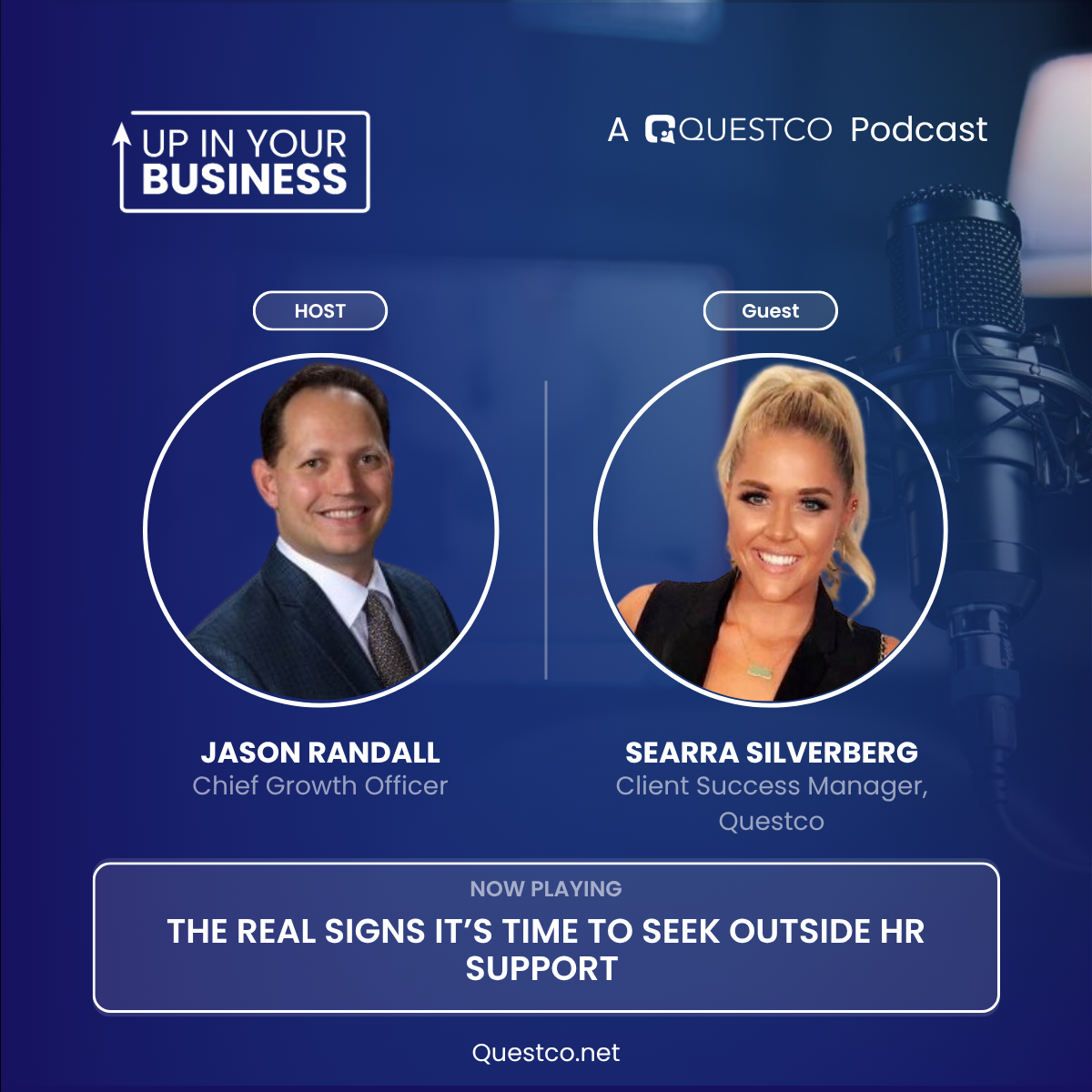
Jason Randall: Most businesses wait to ask, “Should we seek outside help with HR?” until something starts to feel heavier than it should.
When too many questions start landing on the same people, too much time is spent on payroll, benefits, documentation, and follow-up, managers are handling employee issues inconsistently, and leaders are spending real energy on things they never intended to own this directly, that is when it is time to ask:
Is our current setup still the smart move?
This episode is about how to answer that question honestly. When seeking outside help with HR starts to make sense, what leaders tend to get wrong about the decision, and whether the value is actually there when you look beyond price.
To help guide us through this, I’d like to introduce Searra Silverberg to our conversation.
Searra, welcome. It’s good to see you.
Searra Silverberg: Thank you, Jason. It’s an absolute pleasure to be here.
Jason Randall: Well, you’re a go-to person for so many of our clients. I think it’s important, first of all, to tell us a little bit about your background.
Searra Silverberg: My background is that I have worked in the benefits field. I have worked in the PEO realm for about 10 years now. I came into Questco through an acquisition with a small PEO and then really learned the ropes through understanding how the growth of companies works and how we can help Questco grow.
Jason Randall: And of course, you’re adept at all kinds of conversations with our clientele, from the tactical to the very strategic.
I think it’s important to point out that you’re a senior provider on our service side. This is not a sales conversation. This is a helping conversation. Nothing wrong with sales, but today we’re here to talk through what goes on in the business operator’s mind, what they’re dealing with, and how they might want to think about the decision to seek outside help when things start to become a little too much.
Searra Silverberg: Yeah. I think that’s the beauty of someone in a role like mine. The focus isn’t sales. The focus is truly support.
The focus is helping those who may have the talent to win the games but need the teamwork and the intelligence to win a championship. That’s how I look at my support structure and how we can navigate that role together.
That’s the beauty of support: understanding that together we can win and how to help a client do that.
Jason Randall: So let’s talk about the road to that championship.
In this context, it’s when a business is thinking about getting some outside help. Let’s start with the origin. What’s usually going on inside that business when they’re contemplating this decision?
Searra Silverberg: If we keep with the same sports analogy, I think the tipping point usually isn’t the growth itself. It’s the complexity of the business.
What is the complexity of the business? Does it mean the leaders of the company are spending nights Googling employment laws? Are payroll errors starting? Do benefit renewals feel like contract negotiations with a sports agency?
When is it time for you to say, “This is beyond what I can handle, and it’s time to bring in the right support”?
I use the analogy all the time with clients that it’s a lot like a sports team. Winning starts with the proper infrastructure. You can have all the raw talent and win a game, but raw talent can only carry you so far. If you don’t build the proper coaching staff, training systems, support team, and performance structure, you’ll break down under pressure.
That’s not a sales pitch. That’s a truth. We can look at it in sports history. We can look at it in business history. You see it every single day.
That’s where the growth and the tipping point really need to be what we focus on.
Jason Randall: I heard two things in what you said beyond the analogy. There’s a skill and a scale conversation.
One is skill. Something crossed my desk and it’s happening with increasing frequency. I’m in more states. I’m doing more things. I don’t even know where to begin to do the things.
Then there’s another category around scale. I might know what to do, but is this the best use of my time? Is this where I need to be focused given everything else I have going on?
Is that how the world is shaped in a new client situation?
Searra Silverberg: A thousand percent.
When we’re looking at it as a business owner, is this the best use of my time to be worried about payroll errors, benefit renewals, and employment laws?
Running a small or medium-sized business, each state has its own employment laws. Each state has its own negotiation abilities and capabilities.
That’s really where it comes into: where do I want to focus my business, and where do I want to rely on subject matter experts for the support?
That’s the biggest way that a PEO can help an employer capitalize.
Jason Randall: Let’s put a little more paint on that canvas and talk about how it feels, what you see.
What are the most common signs at the starting point that a company’s HR approach isn’t serving them well and they’re looking for help?
Searra Silverberg: The biggest way I see it from the support side is watching a lot of businesses try to run a Super Bowl-caliber organization on a high school coaching budget.
I’m watching a lot of organizations say, “I think I can focus all my time in these areas, and I can wear all 22 different hats,” but they’re not doing a good job at it.
Usually, I try to help them get ahead of it so we’re not at the point of an EEOC claim, a workers’ comp issue, or a situation where we need to put policies into place after something has already happened.
It starts with the basics, just like in sports or anything else. It’s the foundation. It’s the principles. It’s the policies. It’s the way to get ahead of it so we’re not reactive to wage and hour claims, EEOC claims, or audit issues.
The term I use a lot right now with clients is that there are a lot of three-letter agencies after businesses right now. That could be the DOL, the IRS, ICE, or a multitude of different agencies.
Why not get ahead of having to have those conversations and prepare for a better future together?
That’s where we see clients start to say, “Okay, I need help.” Unfortunately, they usually realize it too late because they’re still trying to do things on that high school budget.
But if we want to be a Super Bowl-level company, what are we doing to get to that next level?
Jason Randall: Do you see this decision being made after something has already gone off the rails and there’s a scary letter with some big black font?
Or is it more like, “It hasn’t happened yet, but I know it’s around the corner”?
Are they more proactive or reactive when they come in the door and start to seek your counsel and services?
Searra Silverberg: Unfortunately, I think right now it’s a lot of reactive businesses that are typically getting those letters.
Right now, we’ve been a huge help, thanks to our compliance department, for some of the ICE audits we’re seeing a huge influx of. A lot of the IRS audits are coming post-COVID on some of the loans that people took out.
At that point, it’s a lot harder to help someone unwind what has been done than it is to take a proactive approach.
Jason Randall: And I should point out, it’s not only federal actions that can really set a day off kilter. There are a lot of state-level laws that come into play, even local-level laws.
It’s really hard for a non-practitioner to stay on top of all this stuff.
Searra Silverberg: I couldn’t agree more.
The good news about Questco and what we’re working on is that we operate in all 50 states. We understand the laws and have subject matter experts in those states.
As someone who is Colorado-based, I’m in one of the most complicated states there is, and we’re growing even more complex than California.
When I look at it, I come to an employer and say, “What do you have set up for your secure savings?” They have no idea what that means. What do you have set up for your Colorado family leave or your state and granular-level laws?
You look at states like California, and it goes down to the municipality. It goes down to the city, county, and specific employee jurisdiction.
As a business owner, is that something you want to track? That your employee lives on the border of one county and works in another?
I feel your time is better used in other places.
Jason Randall: We’ve spent a fair amount of time on how it might be too late, or how businesses start a little later than ideal.
But if the best time to start considering support was yesterday, the second-best time is today. Let’s talk about when it makes sense to seek support and what you see out there.
What are the clearest signs you’ve seen that it’s time for a small business to consider some HR support?
Searra Silverberg: I would outline them in a few different areas, and a lot of them come with additional costs that a business may not recognize.
You mentioned it previously: leadership distraction. Is this the best use of leadership’s time?
Then there is compliance exposure. If you start to notice that you have some compliance exposure, I would immediately get assistance.
High employee turnover, or even moderate employee turnover, is a cost to the business.
Poor hiring processes are another sign. What does that actually look like for a client? What does your hiring process look like? Does it include weak onboarding?
Inconsistent policies are a huge one. That’s a big way to know you should bring in help and drive some consistency.
Employee benefits dissatisfaction is another one I always take note of.
And finally, probably the most important, is burnout of your inside teams. That’s the most costly to a business. You watch morale go down, you watch sales go down, you watch people leave.
It’s the cost to the bottom line of the business to replace those employees.
Jason Randall: A lot of these things are a little under the surface, as you mentioned.
Perhaps as an operator, you think, “Maybe I should just hire a person, bring an expert in-house, and that will take care of this. I’ll have an expert in-house. They’re fully devoted to me.”
Again, that makes sense on the surface.
When is an approach like that a good idea, and when does it not work so well?
Searra Silverberg: I think that depends on the size of the company.
Sometimes a business is reactive. They react to what they think they need. But how we know it’s time usually isn’t wanting to wait for the letter with the big black font to come, or for a failed audit, or a wage claim.
It’s typically wanting to prepare ahead of time.
The second your business starts to grow and your time as a business owner can be used in other places, that’s when you should start to look outside.
If we go back to our sports analogy, it’s like waiting for your star player to tear their ACL or MCL, and then all of a sudden investing in conditioning and a training staff.
We don’t want to do things backward like that.
I always recommend an early, proactive approach to the signals we just outlined when it may be best for your company to start incorporating a PEO.
Jason Randall: It strikes me that the approach to make one hire is better than doing nothing. I think we fully agree with that.
The challenge can be that you’re not equipping that one hire for success. One hire has limitations with their own time and breadth of knowledge. It’s hard to find one generalist who can help you in every area a business needs.
It’s a great idea, and we love the enthusiasm, but oftentimes the single hire can feel under-equipped to deal with all that the business faces and then can fall short of expectations.
Searra Silverberg: Perfectly said.
When you talk to these clients on a regular basis, they say, “My passion is truly in plumbing. I’ve done it since I was little. I learned from my mom. I learned from my dad. This is how I do it. The rest of this is administrative stuff I don’t want to have to deal with. I don’t want to have to wait for the government to come knocking on my door or for an employee to complain.”
Their passion is what gives me the ability to do my job. I want to focus on all the things you don’t want to have to do the heavy lifting for, because I need you just as much as you need me when it comes time to running a well-rounded society.
Jason Randall: You might see something on the other end of the coin, where a business doesn’t hire a person, but instead says, “We’ll invest in technology and that will solve the problem. It’s a very slick-looking product. Problem solved. I can do all these things. It has smart AI-driven answers already in there.”
When do you find that compelling, and what might fall short there?
Searra Silverberg: There’s a lot of research still out there.
The biggest thing out there is AI. SHRM is coming out with a new presentation soon about when to use AI and when not to. There are other agencies and legal counsel starting to address when and how to use it, as well as state and federal governments saying when and how to use it.
The analogy I use with clients every day is that trying to run your HR by yourself as a business owner or decision-maker is like trying to build an airplane while you’re already flying it.
It’s not going to work.
We need to take a step back and say, putting a software system, HR platform, or fancy AI in place while you’re building your infrastructure is not going to work.
You have to have the proper people and the proper team in place to actually fly the plane with you. You can’t do it all by yourself.
Jason Randall: The other thing might be pure accuracy.
The number of edge cases we see every day is astronomical. We don’t tend to get the easy questions, or at least they don’t linger for very long. It’s those edge cases, the high-consequence, high-complexity dilemmas that our clients face.
When I’m in those situations, I don’t want to be interacting with technology and hoping I get what I need. I want an expert who has been there a whole bunch of times to be by my side through it.
Searra Silverberg: I couldn’t agree more.
As the stakes rise, your support system matters. Who is your support system? Who do you lean on? Who do you go to?
Is that just another robot that doesn’t fully grasp the conversation and what’s at stake?
This is your livelihood. This is your business. Who do you have supporting you?
Jason Randall: In our business, we’re providing the support. It can be a significant investment to a client.
How does a client get the most out of that relationship? What makes the best client the happiest client that says, “This is a great value, and I’m so glad I made this decision”?
Searra Silverberg: Open communication.
Just as in any relationship, whether that’s a team, a marriage, or a friendship, it’s open communication.
I’ll tell you from day one when you meet with me: I want you to tell me the good, the bad, and the ugly.
I get feedback a lot of times: “How do you know so much about your clients, and how are you so deeply invested in your clients?”
The simple answer is I talk to them. I want to know everything that you know about your business.
You are the expert in your business. I couldn’t run your business for a day. I need you to do what you do best so I can do what I do best.
We don’t work as a team if I don’t know the plays.
That’s the biggest thing I can recommend to anyone. Be able to say, “I’m going to put down these barriers and put down these walls and be 100% transparent in where I need help.”
I can’t help you if I don’t know about it.
Jason Randall: You are so impressive in the results you help our clients achieve and how you go about that.
What are you proudest of? Maybe it’s a story, maybe it’s a client going from A to B. As you think back over your more recent career, what stands out as a client that’s really been helped, and why?
Searra Silverberg: We make such a difference.
There are some clients you help because they say, “I just had a baby. I don’t know where to go or who’s on first. I don’t know what to do.”
And we say, “Have you considered some of these state leaves? Have you considered how to best utilize your practice here? Here’s your simple benefit claim.”
That’s something granular.
Then we have a client who was borderline bankrupt and was really struggling. They had a couple of companies come in and do an audit.
We sat side by side and said, “Let’s go over every I-9. Let’s go over every piece of documentation we have as a company.”
Now I’m watching them thrive as one of Questco’s top companies. The reason for that is the same things we pointed out earlier: policy alignment, lowering employee turnover.
We’re watching them lower their overall costs of what employees should and shouldn’t get paid. There are a lot of FLSA and compliance things that we review there.
Should the employees really be exempt salary with these huge salaries and these giant PTO payouts in states that require PTO payouts?
Watching some of these companies really change everything about their business to be more profitable is the biggest win.
With this particular company, I promise you, in 2020, they told us, “We’re going bankrupt. There’s no chance.”
In 2026, they are a top client for Questco. They are a top client probably in their industry, and they are absolutely thriving.
We have very limited HR complaints from the client as a whole. We interact with them all the time, but we don’t have to interact with them as much as the hand-holding, trying to get them out of constant fires, muddy puddles, and things like that.
Jason Randall: Obviously, an extreme example.
As you think across the clients you serve, something we hear a lot is, “I didn’t know Searra could help me with this,” or, “I didn’t know Questco could help me with this.”
In other words, there are some hidden benefits to the relationship. Why someone may have bought originally isn’t why they stay, and perhaps not what they most appreciate.
I’m curious about your insight around the hidden benefits. What do clients perhaps not appreciate until they’re in it, and then realize the value they’re seeing?
Searra Silverberg: I look at some of Questco’s value propositions and the things we’re really trying to outline to clients.
I look at our departments, from our business operations department sitting here helping you fight every single unemployment insurance claim that comes across your desk. Who has the time as an employer to sit there and fight a UI claim? Yet Questco is nationally ranked for how hard we fight some of these UI claims.
Then you think about the payroll team that’s dealing with every single medical support order, garnishment, payroll compliance, minimum wage audit, and EEOC claim.
Then you go to workers’ comp, which helps you lower your total claims by maybe utilizing a nursing hotline or helping you in other forms and fashions to lower your mod.
Then you go all the way to HR. That’s the gamut we’ve talked about on this call: EEOC claims, FLSA audits, and IRS issues.
Then you look at an accounting team where there isn’t a single tax notice that comes in the door that the accounting team doesn’t research, provide information on, and teach a client how to fight this, where to go next, and who to contact.
When you’re a business owner, all of that is extremely overwhelming.
A lot of the time, it’s all of the invisible work Questco does behind the scenes that I get to see as someone who manages your account as your team’s quarterback every day. A client may or may not know that we’re doing it for them.
There are so many granular things that a PEO brings to your team that a business owner may say, “I can take that in-house,” and then not realize when they have 20 UI claims in a year, or things of that nature.
It’s always the invisible work I wish I could better show to our clients. Until you need us, you don’t always realize that we’re doing it.
It takes one wrong garnishment to get you in trouble with a state or with the government in any capacity. That’s where I think we really shine and provide strong value to our clients.
Jason Randall: That’s a really helpful answer.
When you hear things like, “We help relieve administrative burden,” that makes sense on its face.
But when you go into it and say unemployment insurance claims, as you referenced before, one of these things can take several hours of someone’s time to deal with. And it’s consequential. These can really affect the cost of the business if not handled well.
There’s both the skill in dealing with these things artfully and getting a beneficial outcome, and there’s also the scale, the time that’s leveraged through a team.
That’s a really helpful example among many.
We’ve set out the environment where outside support could become attractive for a business to consider. And we know you can’t start soon enough. By the time something’s already happened, we have some digging out to do.
Let’s help future clients and future business leaders make this decision and provide some practical frameworks for deciding whether the time is right.
If a business leader is trying to decide whether or not to seek outside support, what should they think about first?
Searra Silverberg: I would think about what your goal is.
Are we looking to be just another business? Are we looking to be the top business in our city, state, or county? What does our five-year plan look like? What does our 10-year plan look like? And who do I want to partner with in that?
Is that someone I just want to say, as you alluded to earlier, “I want to put another software system in place”? Or is that someone where I can say, “This company is going to help me grow. They’re going to help me stay ahead of our compliance things. They’re going to help me stay ahead in every facet of my business outside of my day-to-day operations”?
Who do you want that to be? Who do you want next to you when things get tough?
Who do you want that to be if we go through another pandemic or something along those lines?
Who is going to have your back?
Ten out of 10, I can tell you it’s always going to be Questco.
Jason Randall: I think that’s a great specific answer.
I can give a gut answer, having led a business for quite some time. You kind of know: Am I spending my time the way I should be? Do I know what I’m doing here? Is this going in a way that is as well run as perhaps my core operations are?
Or am I settling? Am I making trade-offs?
If I am, maybe I should think about whether there’s a better way.
Searra Silverberg: I couldn’t agree more.
I think you would know better than anyone what that looks like and where your exposures are as a business and where you need to continue to invest your time.
Jason Randall: Let’s say I’ve made a decision as a small business that I want to take the next step. I need to do something because I’m not happy with the outcomes or the way time is being spent here.
Where do you suggest that they start? What should they be looking at? What should they be doing first to help this decision along the way?
Searra Silverberg: Utilizing resources.
Some of the best phone calls are with our sales department when you get someone from client services on the call with them, and they overview and look at what Questco can bring to the table for them.
On a larger scale, look at your business as a whole. What does that look like for you with your policies, with your team’s management, and where do you see that going as a company?
Is that something that’s an internal problem and you can fix it through a couple morale meetings? Or is that something on a much larger scale where maybe we need to review all of our policies and how our business is operating day to day, and where we need to bring in an expert?
Jason Randall: On the other side, what are some traps you see businesses fall into when they’re thinking about what to do?
Whether they chose a different HR support partner, opted for technology, hired internally, or stayed with the status quo, where do you see decisions lead a business astray?
Searra Silverberg: Typically, it’s with whatever is cheapest, fastest, and easiest.
Kind of like any fast food chain. Can I buy something on the dollar menu, and it makes me feel horrible the next day, and it got me nowhere, but it sustained me for the time being?
Or do you look at it like every single meal: if I eat healthy and clean, I perform better?
Same thing in the business. If we provide better services and bring in the proper subject matter experts, that’s where you see the best victories with clients.
The other thing is when clients think they’re the expert. The biggest issue I see on a granular level right now is that a lot of them want to use AI to be their lawyer or subject matter expert.
It’s always the quick go-to. It’s cheap. It’s free. It’s online. It gives you answers that may or may not be accurate, but they think it’s worth the 50/50 shot.
That’s easily the biggest mistake that most people make: watching them make decisions based on something AI gave them.
Jason Randall: In that specific realm, the products are transformational. I think they’re incredibly useful, as long as you understand the context.
The latest research I saw is that AI as a category tends to be about 70% accurate. And 70% is awesome in a lot of ways. It can get a really nice-looking report. It can get us centered and directionally correct.
But I don’t know about you, Searra. I don’t know if I want to rely on a C-minus grade on something that might be really consequential to my business.
Searra Silverberg: I couldn’t agree more.
Knowing I’m going to have the proper people in my corner, with the proper education and certifications to help me, is worth the investment rather than trusting something that’s 70% accurate.
Jason Randall: Of course, not to knock it at all. I think it’s a great tool integrated into our own operations, as well as those of our clients.
We’re by no means anti-technology, AI, or otherwise. I think it’s all about context and not forfeiting judgment blindly to technology.
That human expertise informs these models. There are a lot of flavors to that, and we can help the business get it right.
Searra Silverberg: I couldn’t agree more.
We use AI on a daily basis. I think it’s fantastic for its utilization. I just don’t know that I’m going to let it make HR decisions on my behalf without understanding full context and having human analysis just yet.
Jason Randall: Searra, this has been a fast-moving conversation, with a lot of great insight.
One final question on the substance.
If a business decides they’re not ready to take the next step today, at least let’s give them something.
What should they tighten up or do differently now so they don’t create a bigger problem later?
Searra Silverberg: The biggest thing would be inconsistent policies within companies.
You can look at that at a granular level all the way to the very top of the company.
If I were in your shoes running a high-revenue-generating business and I had inconsistent policies in place, whether that’s an expense report down to an HR policy on how someone requests PTO, inconsistent policies are only going to lead to additional time, leadership distraction, and compliance exposure. It’s going to lead to a whole gamut of things.
If you can get your policies to align and up to state compliance, you’re going to have a much more successful business.
Jason Randall: Well, I certainly enjoyed exploring the dimensions of success, the success that you’ve had with our clients in your role and with our company.
Searra, where can our listeners follow your work or stay connected?
Searra Silverberg: I’d love for you guys to reach out to me on LinkedIn, Searra Silverberg, if I can help you with anything.
Like I said, I have a great sales support team in addition to the team here locally. Feel free to add me and follow me there, and I’d be happy to help in whatever way I can.
Jason Randall: I sure appreciate your insights and perspective today. Thank you so much, Searra.
And to our audience, thank you for tuning into this episode of Up In Your Business.
If this conversation helped you think more clearly about whether your current HR model is still working and how it could be better, please share the conversation with a founder, operator, or finance leader who is weighing that same question.
You can find more resources and more episodes in the show notes, and we’ll see you next time.
Searra Silverberg: Thank you, Jason.